> For the complete documentation index, see [llms.txt](https://academy.pentaho.com/llms.txt). Markdown versions of documentation pages are available by appending `.md` to page URLs; this page is available as [Markdown](https://academy.pentaho.com/pentaho-data-integration/use-cases/streaming-data/mqtt.md).
# MQTT
Publish / Subscribe
{% hint style="info" %}
**Message Queuing Telemetry Transport**
[MQTT](https://www.influxdata.com/integration/mqtt-monitoring/?utm_source=vendor\&utm_medium=referral\&utm_campaign=2022-04-05_spnsr-ctn_python-mqtt-tutorial_tns) is a standard messaging protocol used for the [Internet of Things](https://www.influxdata.com/solutions/industrial-iot/?utm_source=vendor\&utm_medium=referral\&utm_campaign=2022-04-05_spnsr-ctn_python-mqtt-tutorial_tns) (IoT) because it requires minimal resources and can be executed by small microcontrollers found in connected devices.
IoT devices have a real need for this type of lightweight protocol because it guarantees fast and reliable communication with minimal hardware requirements, keeping power consumption and manufacturing costs low.
IoT devices like smart temperature sensors regularly transmit information over the internet, but before you can deduce any meaningful information from that measurement, you need to store it in an adequate database. Smart sensor measurements are not complex, but they are highly dependent on the time constant — when the measurement was taken — and as a result, time-series databases, like InfluxDB, offer an efficient option to store and manipulate that kind of data.
{% endhint %}
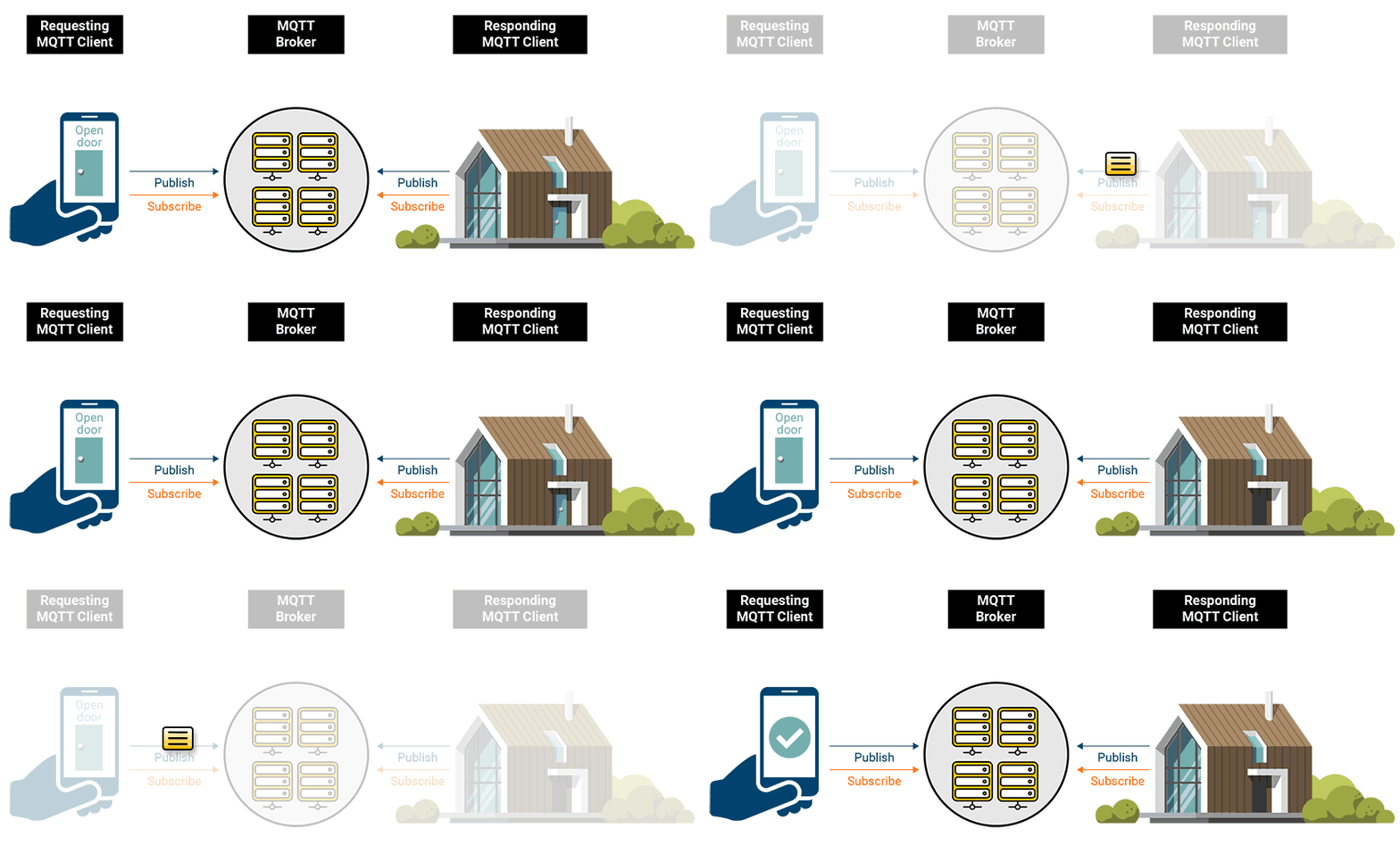
MQTT - Publish / Subscribe
***
---
# Agent Instructions
This documentation is published with GitBook. GitBook is the documentation platform designed so that both humans and AI agents can read, navigate, and reason over technical content effectively. Learn more at gitbook.com.
## Querying This Documentation
If you need additional information that is not directly available in this page, you can query the documentation dynamically by asking a question.
Perform an HTTP GET request on the current page URL with the `ask` query parameter, and the optional `goal` query parameter:
```
GET https://academy.pentaho.com/pentaho-data-integration/use-cases/streaming-data/mqtt.md?ask=&goal=
```
`ask` is the immediate question: it should be specific, self-contained, and written in natural language.
`goal` is optional and describes the broader end goal you are ultimately trying to accomplish on behalf of the user. GitBook uses it to tailor the answer towards what is most useful for that goal.
The response will contain a direct answer to the question and relevant excerpts and sources from the documentation.
Use this mechanism when the answer is not explicitly present in the current page, you need clarification or additional context, or you want to retrieve related documentation sections.