> For the complete documentation index, see [llms.txt](https://academy.pentaho.com/llms.txt). Markdown versions of documentation pages are available by appending `.md` to page URLs; this page is available as [Markdown](https://academy.pentaho.com/pentaho-data-integration/use-cases/streaming-data/amqp.md).
# AMQP
Advanced Message Queuing Protocol (AMQP) is an open source published standard for asynchronous messaging by wire ..
{% hint style="info" %}
#### **Advanced Message Queuing Protocol**
AMQP (Advanced Message Queuing Protocol) brokers facilitate high-performance, reliable, and scalable messaging services between applications. This makes them ideal for scenarios needing:
* **Asynchronous Communication**: Decoupling producers and consumers, allowing them to communicate without waiting for responses, enhancing application responsiveness.
* **System Decoupling**: Applications communicate through messages rather than direct method calls, improving modularity and scalability.
* **Resilience and Fault Tolerance**: Messages can be queued, ensuring no loss of information on temporary failures, contributing to system robustness.
* **Load Balancing**: Efficient distribution of message processing across multiple consumer instances, optimizing resource utilization and throughput.
* **Distributed Systems Communication**: Simplifying communication patterns in microservices or distributed architectures by providing a unified messaging platform.
AMQP brokers, such as RabbitMQ, offer a standardized, open solution to address these requirements, making them a cornerstone in modern distributed application architectures.
{% endhint %}
AMQP Model
{% tabs %}
{% tab title="Exchanges" %}
{% hint style="info" %}
**Exchanges**
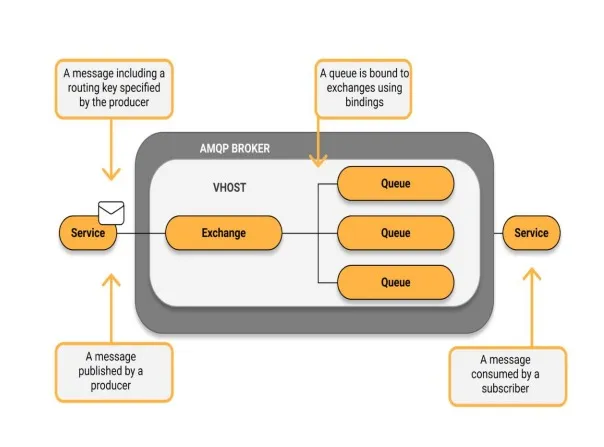
Messages are not published directly to a queue; instead, the producer sends messages to an exchange. An exchange is responsible for routing the messages to different queues with the help of bindings and routing keys.
A **binding** is a link between a queue and an exchange.
The **routing key** is a message attribute the exchange looks at when deciding how to route the message to queues (depending on exchange type).
Exchanges, connections, and queues can be configured with parameters such as *durable, temporary,* and *auto delete* upon creation. Durable exchanges survive server restarts and last until they are explicitly deleted. Temporary exchanges exist until RabbitMQ is shut down. Auto-deleted exchanges are removed once the last bound object is unbound from the exchange.
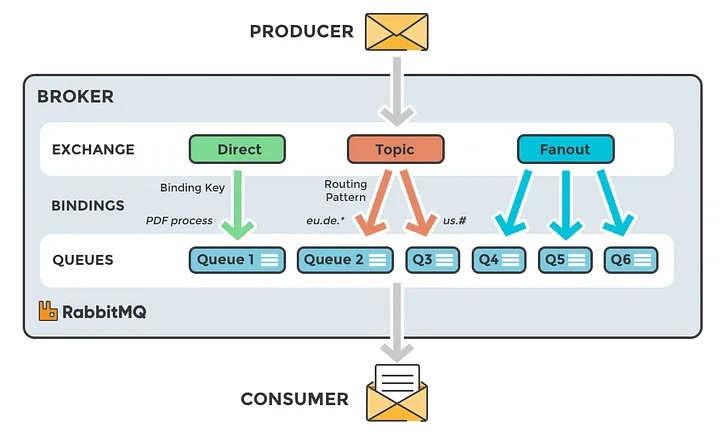
In RabbitMQ, there are four different types of exchanges that route the message differently using different parameters and bindings setups. Clients can create their own exchanges or use the predefined default exchanges which are created when the server starts for the first time.
{% endhint %}
Exchanges
{% tabs %}
{% tab title="Fanout" %}
{% hint style="info" %}
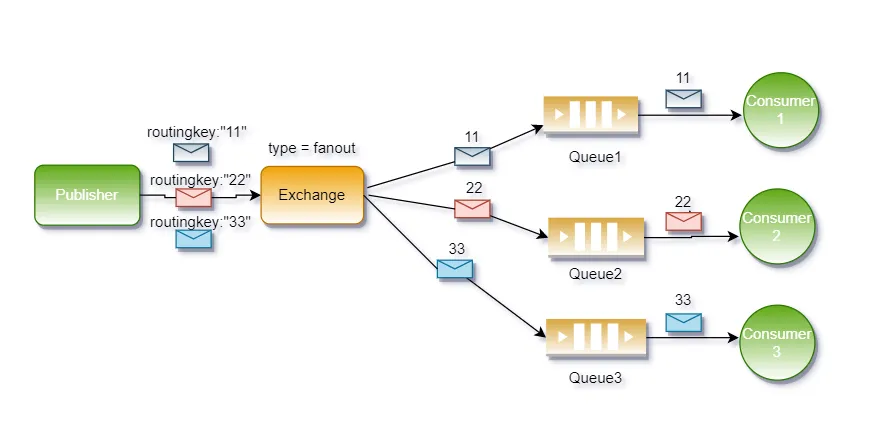
This is the default exchange type and it just broadcasts all the messages it receives to all the queues it knows. Above example code shows how to define this exchange type and if exchange type is not defined then by default it will be **fanout**. In fanout exchange type headers, binding or routing keys will be ignored even if it is provided and messages will be published to all the available queues.
{% endhint %}
Fanout
{% hint style="info" %}
Fanout exchanges can be useful when the same message needs to be sent to one or more queues with consumers one at a time based on default Round Robin method. Hence there is a possibility that the message 11 will be received by Consumer 2 and message 22 will be received by consumer 2.
{% endhint %}
{% endtab %}
{% endtabs %}
{% endtab %}
{% tab title="Queues" %}
{% hint style="info" %}
**Queues**
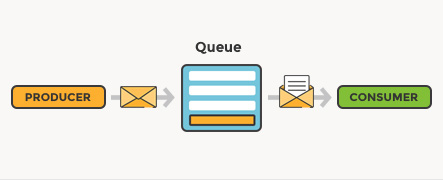
In RabbitMQ, **queues** are central structures where messages are stored for a consuming application or worker to process them. Messages flow into the queue from producers and wait there until a consumer retrieves and processes them, allowing for asynchronous communication and workload decoupling between producers and consumers.
Queues have several important characteristics:
* **Durability:** Queues can be durable or transient. Durable queues are saved on disk and survive broker restarts, whereas transient queues do not.
* **Exclusivity:** An exclusive queue is used by only one connection and is deleted when that connection closes.
* **Auto-delete:** An auto-delete queue will delete itself when the number of consumers drops to zero.
RabbitMQ allows for the dynamic creation of queues via client libraries, and these queues can be configured with various parameters (e.g., durability, exclusivity, auto-deletion) depending upon the application's requirements. Messages in a queue are typically consumed in a FIFO (first in, first out) manner, although RabbitMQ supports various other message dispatching strategies.
{% endhint %}
Queues
{% endtab %}
{% endtabs %}
#### Workshops
{% tabs %}
{% tab title="RabbitMQ" %}
{% hint style="info" %}
RabbitMQ is a widely adopted open-source AMQP broker, renowned for its performance, reliability, and scalability. It enables asynchronous communication, system decoupling, resilience, load balancing, and seamless distributed system integration, making it an essential component in modern application architectures.
RabbitMQ provides a flexible routing model, multiple messaging protocols, and a broad range of client libraries, facilitating the development of complex messaging solutions for various computing environments.
{% endhint %}
{% content-ref url="/pages/ssZBUm6YPen1xIkwxaRu" %}
[RabbitMQ](/pentaho-data-integration/use-cases/streaming-data/amqp/rabbitmq.md)
{% endcontent-ref %}
{% endtab %}
{% tab title="Second Tab" %}
{% endtab %}
{% endtabs %}
---
# Agent Instructions
This documentation is published with GitBook. GitBook is the documentation platform designed so that both humans and AI agents can read, navigate, and reason over technical content effectively. Learn more at gitbook.com.
## Querying This Documentation
If you need additional information that is not directly available in this page, you can query the documentation dynamically by asking a question.
Perform an HTTP GET request on the current page URL with the `ask` query parameter, and the optional `goal` query parameter:
```
GET https://academy.pentaho.com/pentaho-data-integration/use-cases/streaming-data/amqp.md?ask=&goal=
```
`ask` is the immediate question: it should be specific, self-contained, and written in natural language.
`goal` is optional and describes the broader end goal you are ultimately trying to accomplish on behalf of the user. GitBook uses it to tailor the answer towards what is most useful for that goal.
The response will contain a direct answer to the question and relevant excerpts and sources from the documentation.
Use this mechanism when the answer is not explicitly present in the current page, you need clarification or additional context, or you want to retrieve related documentation sections.