> For the complete documentation index, see [llms.txt](https://academy.pentaho.com/llms.txt). Markdown versions of documentation pages are available by appending `.md` to page URLs; this page is available as [Markdown](https://academy.pentaho.com/pentaho-data-integration/data-integration/components/configuring-pdi-ui.md).
# Configuring PDI UI
PDI UI configuration settings ..
{% hint style="warning" %}
#### **Workshop - Configuring PDI**
Configure Spoon before you build transformations and jobs. Set a few defaults that speed up daily work.
You will start Spoon, review the Welcome page, and update UI options.
**What You'll Accomplish:**
* Start Spoon and confirm your install.
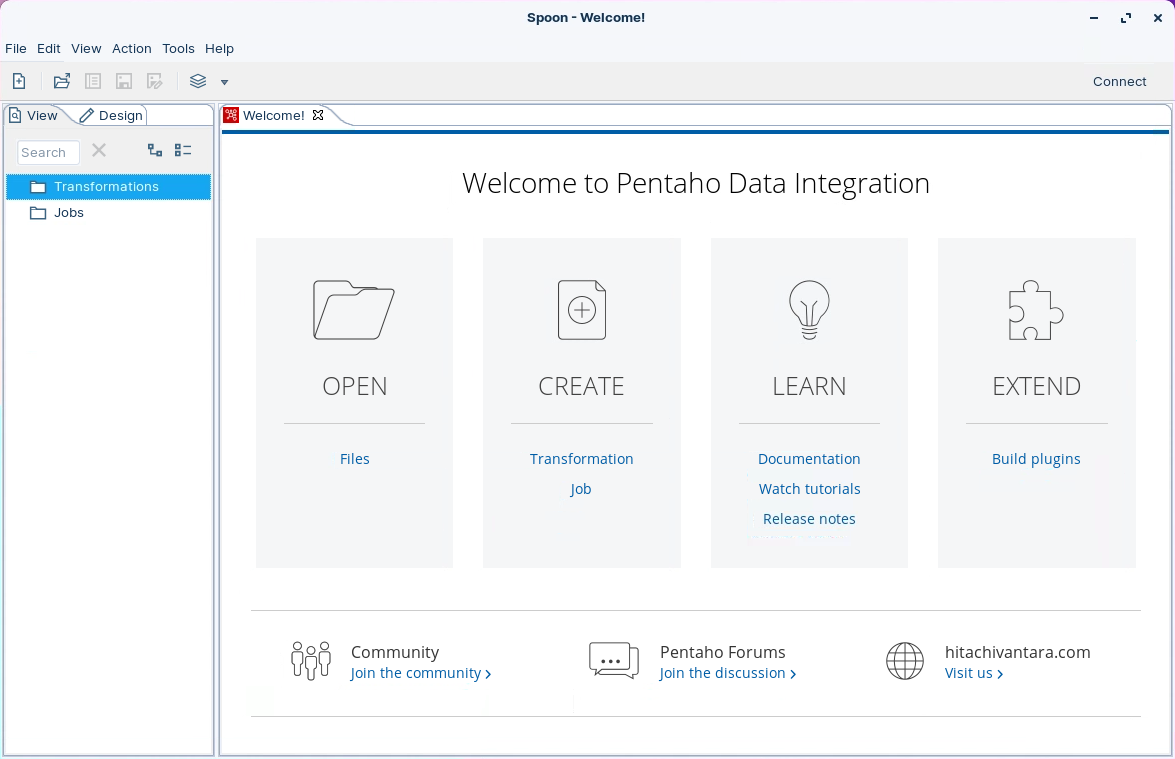
* Find docs and community links from the Welcome page.
* Update General and Look & Feel options.
* Switch perspectives and understand what changes.
You will finish with a clean, predictable workspace. You will know where to change these settings later.
**Prerequisites:** Pentaho Data Integration installed and ready to launch
**Estimated Time:** 10 minutes
{% endhint %}
***
{% hint style="info" %}
#### **Configuring PDI UI**
Use **Tools > Options** to configure Spoon. Start with **General** and **Look & Feel**.
{% endhint %}
{% tabs %}
{% tab title="1. Welcome Page" %}
{% hint style="info" %}
#### **Welcome page**
The Welcome page has links to:
* Documentation
* Community Forum
{% endhint %}
1. Start Pentaho Data Integration.
{% hint style="info" %}
{% tabs %}
{% tab title="Windows (PowerShell)" %}
```powershell
Set-Location C:\Pentaho\design-tools\data-integration
.\spoon.bat
```
{% endtab %}
{% tab title="macOS / Linux" %}
```bash
cd ~/Pentaho/design-tools/data-integration
./spoon.sh
```
{% endtab %}
{% endtabs %}
{% endhint %}
2. The PDI UI - Spoon will be displayed.
Welcome screen
{% endtab %}
{% tab title="2. Modify Look & Feel" %}
{% hint style="info" %}
#### **Kettle Options**
Set a few defaults once. It reduces prompts and visual noise.
{% endhint %}
1. In Spoon, click **Tools > Options**.
2. Open the **General** tab.
kettle options - general
* [ ] Uncheck the ‘Show tips at startup?’ checkbox.
* [ ] Uncheck the ‘Use database cache’ checkbox.
* [ ] Uncheck the ‘Show repository dialog at startup?’ checkbox.
* [ ] Uncheck the ‘Ask user when exiting?’ checkbox.
3. Open the **Look & Feel** tab.
4. Review these settings and update as needed:
* **Grid size** and **snap** behavior.
* Canvas look (colors, anti-aliasing).
* **Preferred language** and **alternative language**.
Kettle options - look & feel
{% embed url="" %}
{% endtab %}
{% tab title="3. Perspectives" %}
{% hint style="info" %}
#### **Perspectives**
Use perspectives to switch your workspace. You can move between design and scheduling views.
Switch between:
* Designing ETL jobs and transformations
* Scheduling jobs and transformations
Click the **Perspective** icon in the toolbar to switch.
{% endhint %}
Perspectives
{% hint style="info" %}
You must connect to a repository to schedule jobs and transformations.
{% endhint %}
{% embed url="" %}
{% endtab %}
{% endtabs %}
---
# Agent Instructions
This documentation is published with GitBook. GitBook is the documentation platform designed so that both humans and AI agents can read, navigate, and reason over technical content effectively. Learn more at gitbook.com.
## Querying This Documentation
If you need additional information that is not directly available in this page, you can query the documentation by asking a question.
Perform an HTTP GET request on the following URL with the `ask` and `goal` query parameters:
```
GET https://academy.pentaho.com/pentaho-data-integration/data-integration/components/configuring-pdi-ui.md?ask=&goal=
```
`ask` is the immediate question: it should be specific, self-contained, and written in natural language.
`goal` is what the user is ultimately trying to achieve, the reason they need the answer. Sharing it helps GitBook give you a better, more relevant answer. A goal is most helpful when it describes the outcome the user wants rather than restating the question. For example, with `ask=how do I create an API token`, a goal like `automate deployments from our CI pipeline` lets GitBook tailor the answer to that use case.
The response will contain a direct answer to the question and relevant excerpts and sources from the documentation.
Use this mechanism when the answer is not explicitly present in the current page, you need clarification or additional context, or you want to retrieve related documentation sections.