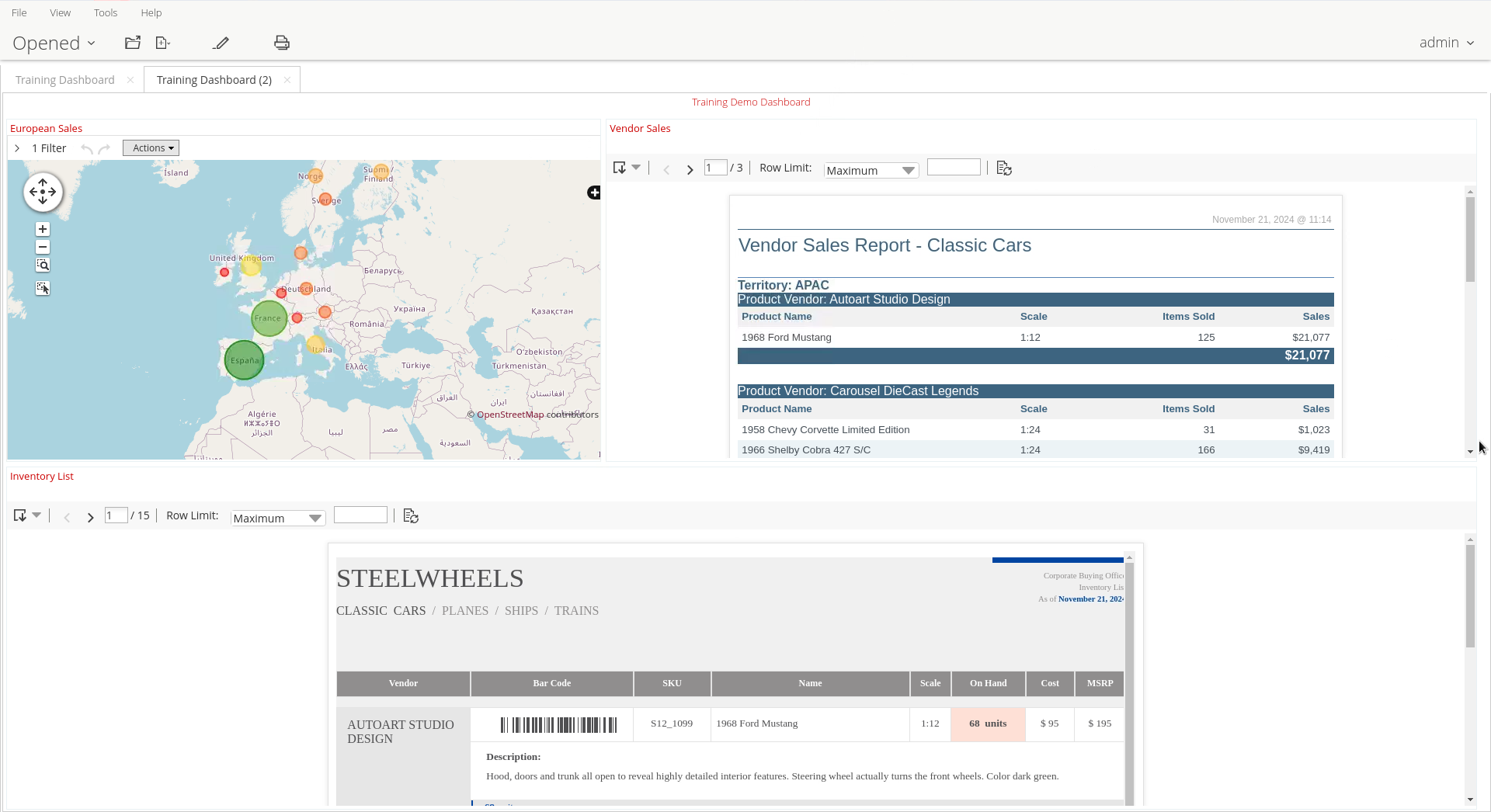
# Vendor Sales

{% hint style="warning" %}

#### Workshop - Vendor Sales

Dashboards transform isolated reports into cohesive business intelligence experiences by bringing multiple data views together in a single, interactive interface. In this foundational workshop, you'll learn to build report-based dashboards using Pentaho Dashboard Designer, discovering how to combine existing reports, analyses, and visualizations into unified business views. You'll master the essential skill of creating dashboard prompts that allow users to filter multiple reports simultaneously, turning static report collections into dynamic, interactive decision-support tools.

In this hands-on workshop, you'll experience the complete dashboard creation workflow, from selecting layout templates and themes through adding content and implementing interactive prompts. You'll learn how to leverage existing reports created in Interactive Reporting, Analyzer, and Report Designer by incorporating them into dashboard panels, understanding when report-based dashboards are the optimal choice for your business intelligence needs. You'll discover the power of dashboard prompts that cascade filtering across multiple reports, creating synchronized views that respond to user selections. You'll also develop the practical skills needed to configure prompt controls, connect them to report parameters, and design intuitive user interfaces that make complex data exploration accessible to business users.

**What You'll Accomplish:**

* Select and apply dashboard layout templates (2 over 1 configuration) and themes (Ruby theme) to establish the visual foundation
* Configure dashboard properties including title (Training Demo Dashboard) and panel sizing
* Add existing reports to dashboard panels by selecting from the repository (European Sales geo map, Vendor Sales interactive report, Inventory List)
* Resize dashboard panels to create balanced, functional layouts
* Create interactive dashboard prompts with multiple control types (buttons for Territory selection)
* Build metadata-driven prompts by querying the Orders data source for Territory values
* Configure prompt properties including display orientation (horizontal), multiple selection capability, and null value exclusion
* Associate dashboard prompts with report parameters to create synchronized filtering across reports
* Create additional prompts for Product Line filtering following established patterns
* Test dashboard interactivity by selecting different territories and product lines to verify prompt behavior

By the end of this workshop, you'll have created a functional, interactive dashboard that demonstrates the power of combining multiple reports with coordinated filtering. You'll understand when to choose report-based dashboards over other approaches, recognizing that this pattern excels when you need to reuse existing reports and maintain consistency across your reporting environment. You'll have mastered the critical skill of creating dashboard prompts that transform static report collections into interactive analytical experiences, enabling business users to explore data across multiple views simultaneously.&#x20;

**Prerequisites:** Pentaho Business Analytics Server with sample reports (European Sales geo map, Vendor Sales interactive report, Inventory List) available in the Steel Wheels folder\
**Estimated Time:** 35-40 minutes
{% endhint %}

<figure><img src="https://content.gitbook.com/content/iyGCAvfJ7v68TnXf8icC/blobs/IQK2uJ2KbrXelLFxBlqd/image.png" alt=""><figcaption><p>Vendor Sales - prompts</p></figcaption></figure>

{% tabs %}
{% tab title="Template" %}
{% hint style="info" %}

#### Dashboard Templates

Creating a dashboard in Dashboard Designer is as simple as choosing a layout template, theme, and the content you want to display.
{% endhint %}

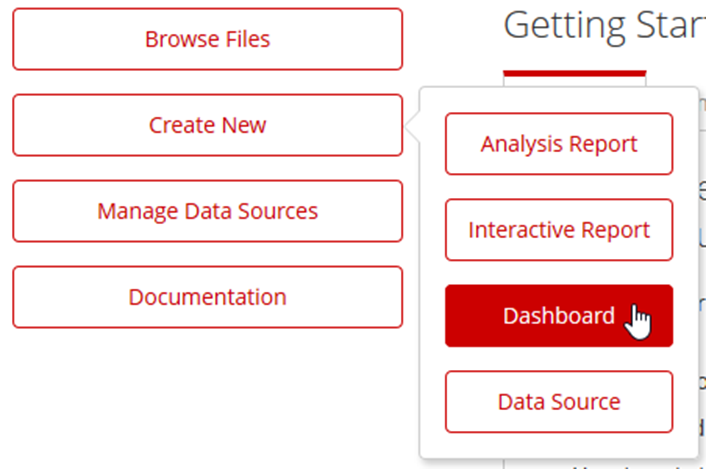
1. From the User Console Home Perspective, click Create New -> Dashboard.

<figure><img src="https://content.gitbook.com/content/iyGCAvfJ7v68TnXf8icC/blobs/hqiXteKKpkzCY1Zabk4d/image.png" alt="" width="353"><figcaption><p>Dashboard Designer</p></figcaption></figure>

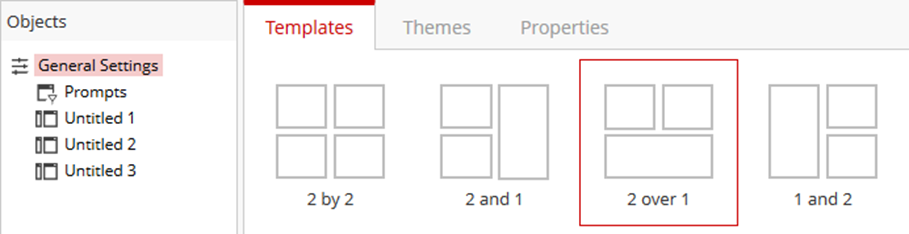
&#x20;2\. To select the 2 over 1 template, on the Templates tab, click 2 over 1.

<figure><img src="https://content.gitbook.com/content/iyGCAvfJ7v68TnXf8icC/blobs/5UToZOHWz4Nlo6cSg4me/image.png" alt="" width="563"><figcaption><p>Dashboard Templates</p></figcaption></figure>

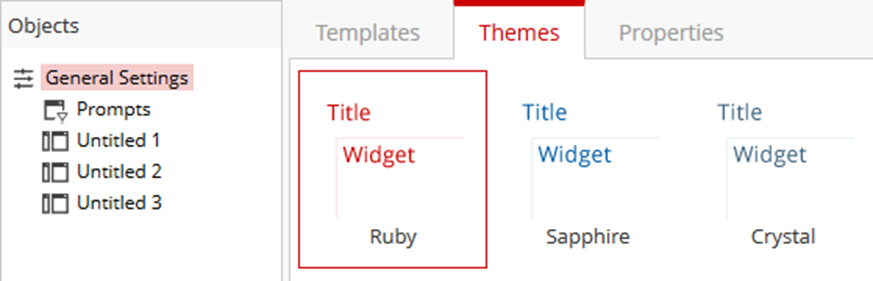
3. To view the available themes, click the Themes tab.

<figure><img src="https://content.gitbook.com/content/iyGCAvfJ7v68TnXf8icC/blobs/SbV3QoXvpEgtUvCwlmyd/image.png" alt="" width="563"><figcaption><p>Themes</p></figcaption></figure>

4. Keep the default Ruby theme.
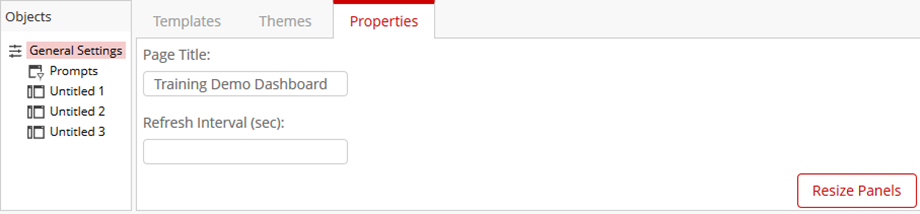
5. Enter a title for the dashboard, click the Properties tab.
6. Type: Training Demo Dashboard.

<figure><img src="https://content.gitbook.com/content/iyGCAvfJ7v68TnXf8icC/blobs/qAYx17NaWQSwEUeTQbOP/image.png" alt=""><figcaption><p>Dashboard Properties</p></figcaption></figure>

{% hint style="info" %}
Notice the button allowing you to resize the panels and the Refresh Interval field.
{% endhint %}

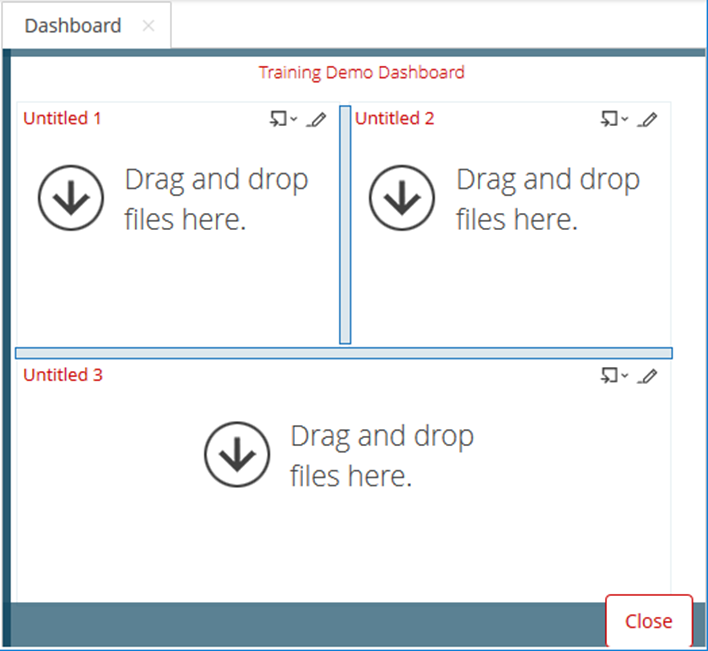
7. To resize the panels, click the Resize Panels button.
8. Drag the vertical line about an inch to the left to make the Untitled 1 panel smaller, and then in the lower right corner of the canvas.
9. Click Close.

{% hint style="info" %}
The blue horizontal and vertical lines, allow you to resize the panels.
{% endhint %}

<figure><img src="https://content.gitbook.com/content/iyGCAvfJ7v68TnXf8icC/blobs/htNJeLuPqJyTet0mLvG2/image.png" alt="" width="531"><figcaption><p>Resize Dashboard</p></figcaption></figure>
{% endtab %}

{% tab title="Content" %}
{% hint style="info" %}
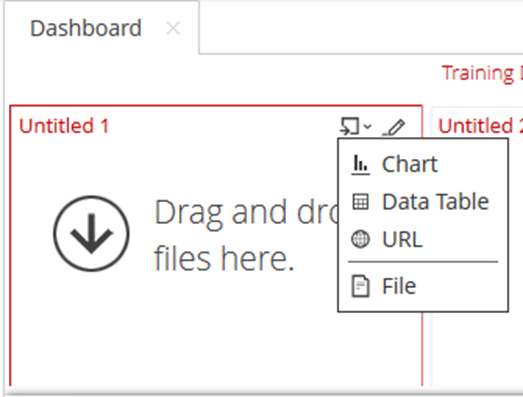
You can easily add reports created with Interactive Reporting, Analyzer, and Report Designer to the dashboard by dragging content from the Files pane to a panel on the dashboard.&#x20;

Alternatively, you can click the Add Content icon on the panel title bar and then select File.
{% endhint %}

1. Highlight ‘Untitled1’ dashboard pane.
2. Click on the dropdown ‘Content’ icon in the top right, and select File.

<figure><img src="https://content.gitbook.com/content/iyGCAvfJ7v68TnXf8icC/blobs/DPsCw2as0uYNuKxO6ZYe/image.png" alt="" width="392"><figcaption><p>Add content from Repository</p></figcaption></figure>

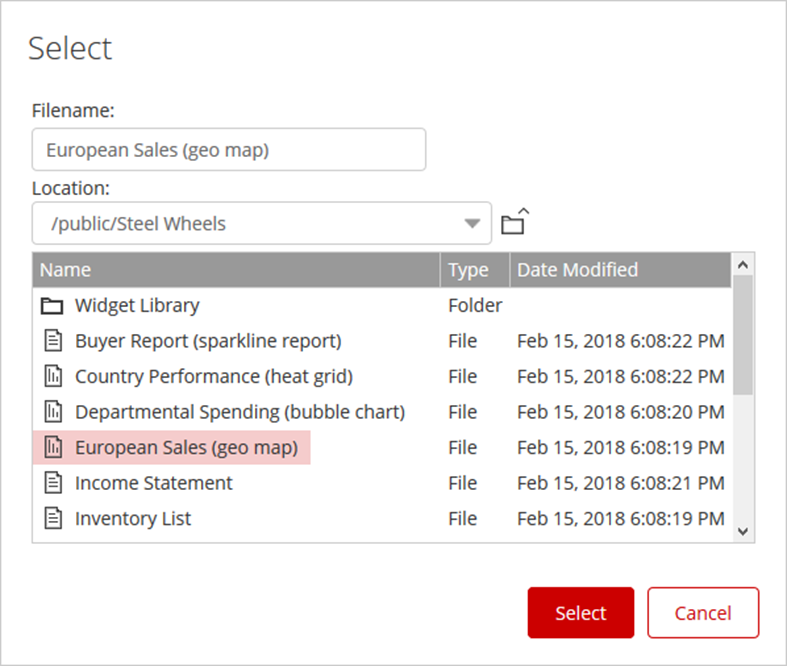
3. From the Files pane, Select: European Sales (geo map).

<figure><img src="https://content.gitbook.com/content/iyGCAvfJ7v68TnXf8icC/blobs/9sFQnczQVxwRAJIEu8fb/image.png" alt="" width="563"><figcaption><p>Add European Sales (geomap)</p></figcaption></figure>

4. In the Title text box, type European Sales
5. Click Apply.

<figure><img src="https://content.gitbook.com/content/iyGCAvfJ7v68TnXf8icC/blobs/ZIZEPobqSAZ64g01B9HD/image.png" alt=""><figcaption><p>Title</p></figcaption></figure>

6. To add a report created with Interactive Reporting to the dashboard, from the Browse pane:
7. Click the main Steel Wheels folder (Public -> Steel Wheels).
8. Select: Vendor Sales Report (interactive report).
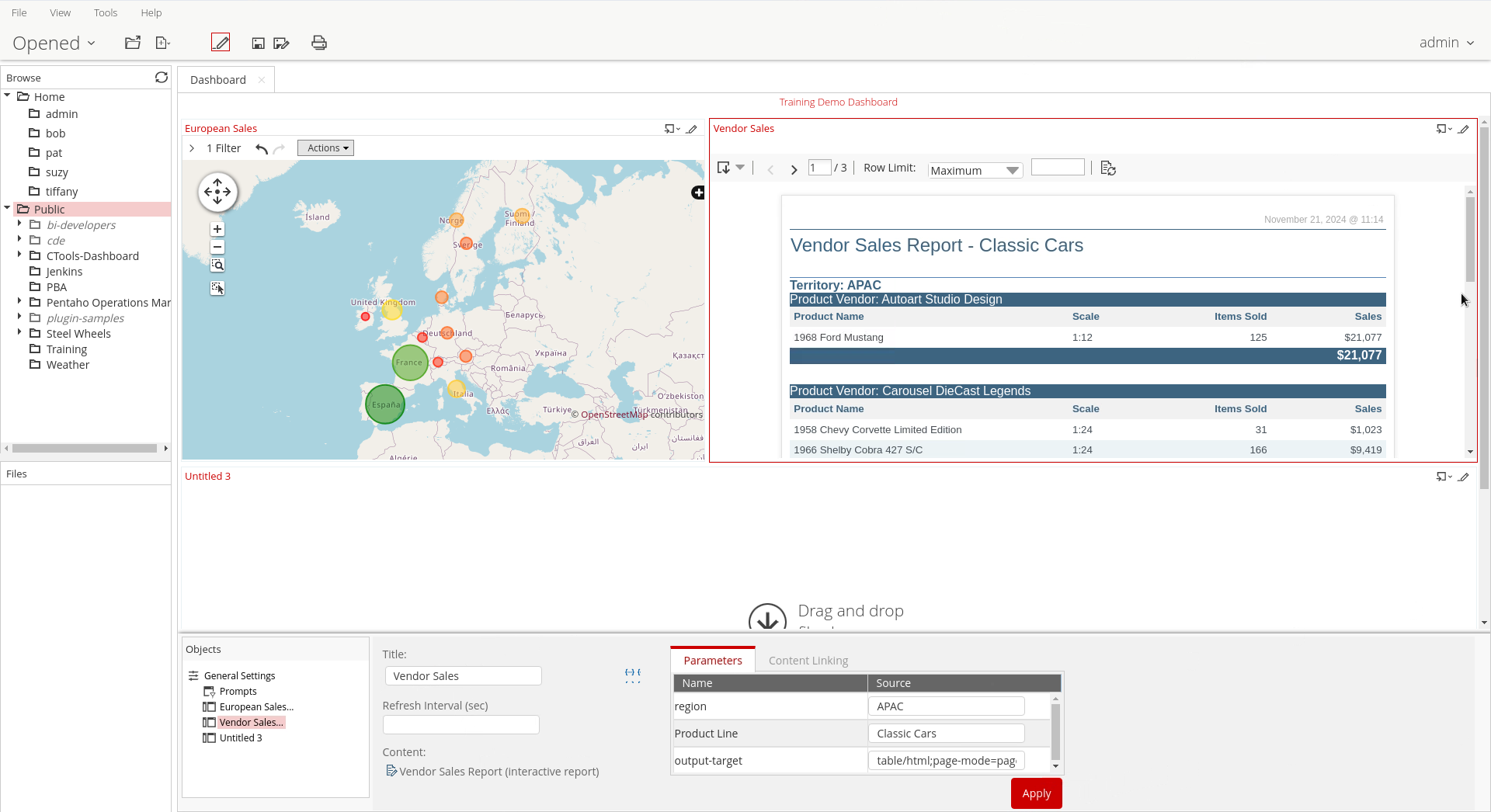
9. In the Title text box, type Vendor Sales.
10. Click Apply.

<figure><img src="https://content.gitbook.com/content/iyGCAvfJ7v68TnXf8icC/blobs/7iMrZggkczh82qvypLMl/image.png" alt=""><figcaption><p>Vendor Sales</p></figcaption></figure>

{% hint style="info" %}
In the bottom pane display the parameters for region and Product Line used in the report.&#x20;

Later, we will use these parameters as dashboard prompts.
{% endhint %}

11. Add a report created with Report Designer to the dashboard, from the Files pane, click Inventory List.
12. In the Title text box, type Inventory List
13. Click Apply.

<figure><img src="https://content.gitbook.com/content/iyGCAvfJ7v68TnXf8icC/blobs/QSZLSd91cKQwIxi6Bmt7/image.png" alt=""><figcaption><p>Training Demo Dashboard</p></figcaption></figure>
{% endtab %}

{% tab title="Prompts" %}
{% hint style="info" %}
You can create dashboard prompts to apply to the content within the entire dashboard. Dashboard prompts can only be applied to individual reports within the dashboard if the report filter is set up as a parameter.

So .. we're going to create dashboard prompts for Territory and Product Line, then apply the dashboard prompts to the Vendor Sales Report in the dashboard.
{% endhint %}

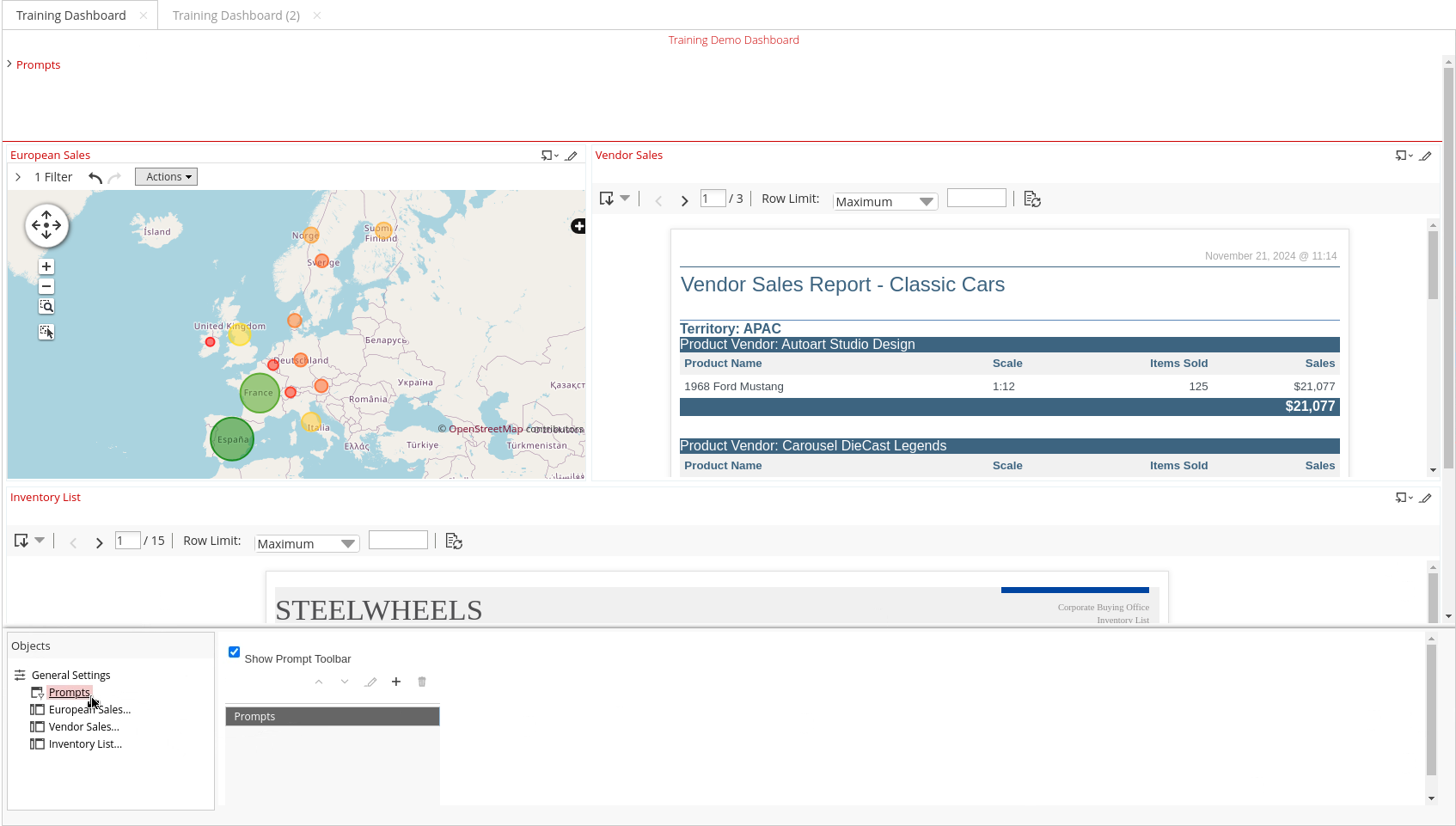
1. To display the Prompt toolbar, from the Objects list in the bottom pane, click Prompts, then click the checkbox for Show Prompt Toolbar.

<figure><img src="https://content.gitbook.com/content/iyGCAvfJ7v68TnXf8icC/blobs/UXMTEs9kGjqWBuZQTluX/image.png" alt=""><figcaption></figcaption></figure>

{% hint style="info" %}
The Prompts pane appears at the top of the dashboard. You can resize the pane from the General Settings > Properties tab.
{% endhint %}

2. Add a prompt, in the bottom pane, click the + icon.

{% hint style="info" %}
The Name field displays in the Prompt toolbar, therefore it is a good idea to use a prompt such as “Select one or more Territories:” for the Name.

The Control area shows the various types of prompts available: drop-down, list, radio button, checkbox, buttons, text field, or date picker.

The Data area identifies the values for the prompt. You can type a static list of values, create a SQL query to pull the values from a file, or use a metadata list from a defined data source.

The Control Properties area shows different options depending on the type of prompt.
{% endhint %}

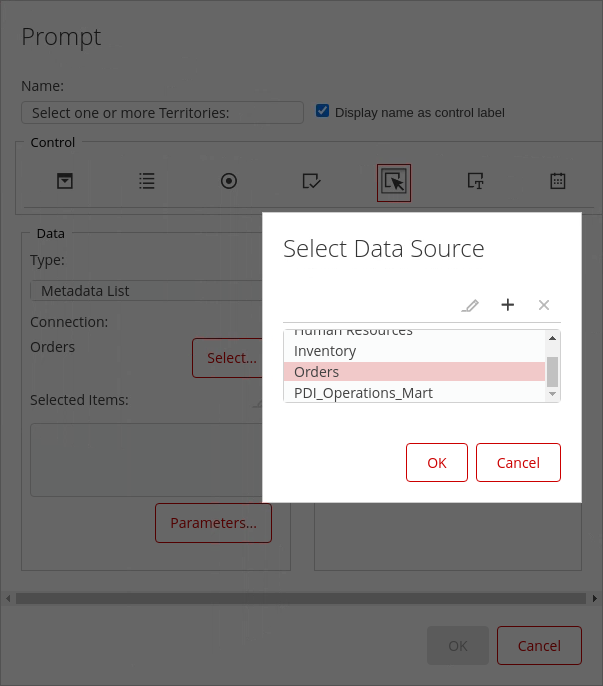
<figure><img src="https://content.gitbook.com/content/iyGCAvfJ7v68TnXf8icC/blobs/MxSKMm0PMM0IS6LbsaUX/image.png" alt=""><figcaption><p>Orders - Metadata List</p></figcaption></figure>

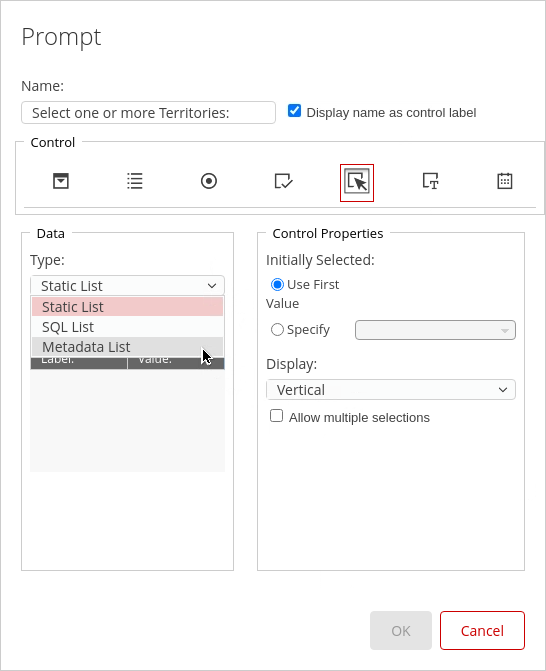
3. In the Name text box, type: Select one or more Territories:
4. To create a list of selection buttons, in the Control area, click the Buttons icon.
5. To use a metadata list for the prompt, in the Data area, from the Type drop-down list, select Metadata List, and then click Select.
6. To select the Orders data source, click Orders, and then click OK.

<figure><img src="https://content.gitbook.com/content/iyGCAvfJ7v68TnXf8icC/blobs/kBdla8P0mxIqxmtluQNp/image.png" alt=""><figcaption></figcaption></figure>

{% hint style="info" %}
The Query Editor window opens.&#x20;

Create a simple query to pull the list of territories from the Customer table, excluding Null values. In other words, a statement to only return the territories that are not null.
{% endhint %}

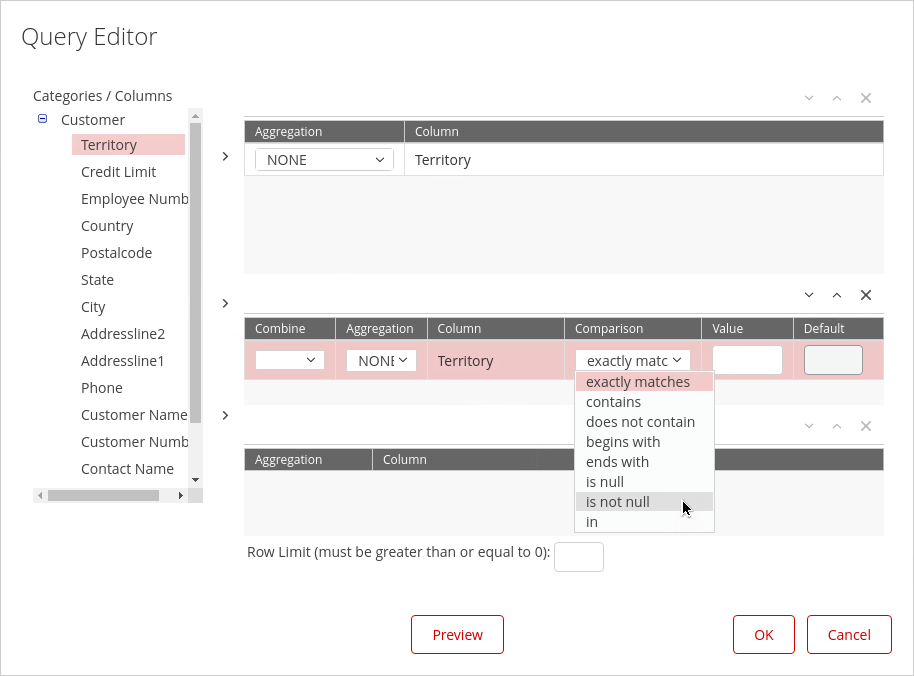
<figure><img src="https://content.gitbook.com/content/iyGCAvfJ7v68TnXf8icC/blobs/X9NrDN661EvYdpoIivOV/image.png" alt=""><figcaption><p>Metadata Query - Territory</p></figcaption></figure>

7. Select: Territory, in the Categories/Columns list:

&#x20;      • Click the plus sign for Customer.

&#x20;      • Click Territory.

&#x20;      • Click the > arrow to move Territory to the Selected Columns.

8. Specify a condition to return Territory values that are not null:

&#x20;      • Click the middle arrow to move Territory to the Conditions.

&#x20;      • From the Comparison drop-down list, select is not null.

&#x20;      • Click OK.

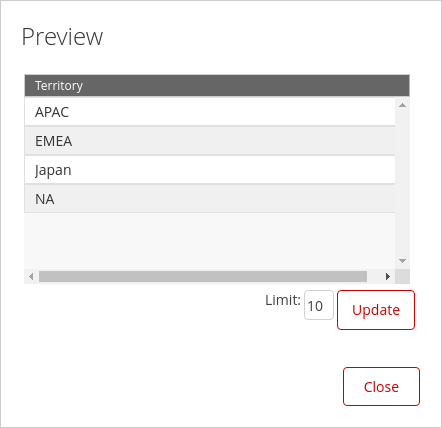
9. Click Preview and check that the list is what you expect.

<figure><img src="https://content.gitbook.com/content/iyGCAvfJ7v68TnXf8icC/blobs/0aLjA6nkt8G27AvcIVWR/image.png" alt=""><figcaption><p>Preview List</p></figcaption></figure>

10. Click Close.
11. In the Control Properties area:

&#x20;      • From the Display drop-down list, select Horizontal.

&#x20;      • Click the checkbox for Allow multiple selections.

&#x20;      • Click OK.

<figure><img src="https://content.gitbook.com/content/iyGCAvfJ7v68TnXf8icC/blobs/8dgMQ04do4WZ6DWSgj9B/image.png" alt=""><figcaption><p>Associate the prompt with Vendor Sales report.</p></figcaption></figure>

13. Apply the Territory prompt to the Vendor Sales Report, from the Objects list in the bottom pane:

&#x20;     • Click Vendor Sales Report.

&#x20;     • From the region Source drop-down list, select Select one or more territories:

&#x20;     • Click Apply.

14. Test the prompt, on the list of prompt buttons:

&#x20;     • Deselect APAC.

&#x20;     • Select: EMEA.

15. Repeat the workflow to create a prompt for: Product Line
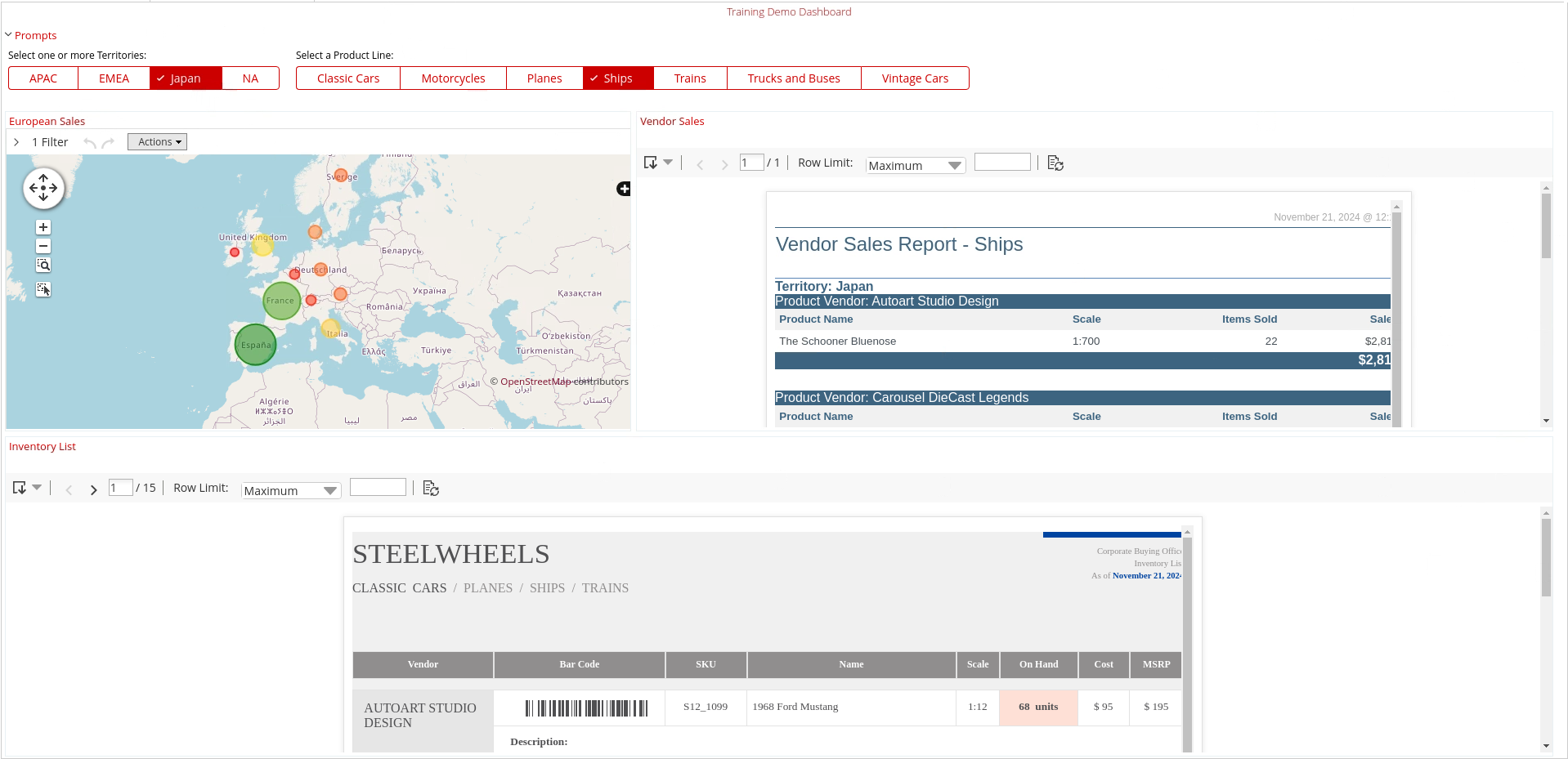
16. View the results in the Vendor Sales Report.

<figure><img src="https://content.gitbook.com/content/iyGCAvfJ7v68TnXf8icC/blobs/fT1Rqc09eOgPpxFcQmTM/image.png" alt=""><figcaption><p>Vendor Sales</p></figcaption></figure>
{% endtab %}
{% endtabs %}