> For the complete documentation index, see [llms.txt](https://academy.pentaho.com/llms.txt). Markdown versions of documentation pages are available by appending `.md` to page URLs; this page is available as [Markdown](https://academy.pentaho.com/pentaho-data-integration/data-integration/enterprise-solution/jobs/job-hello-world.md).
# Job - Hello World
What's a Pentaho Job ..
{% hint style="warning" %}
**Workshop - Job**
In this workshop, we're going to create & configure a simple Job.
The concepts learnt, help to build the foundation necessary for creating any Job.
* Create a new Job.
* Add entries and configure hops.
{% endhint %}
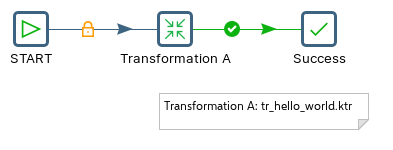
Pentaho Job
{% tabs %}
{% tab title="1. START" %}
{% hint style="info" %}
START defines the starting point for job execution. Every job must have one (and only one) Start. Unconditional job hops only are available from a Start job entry. The start job entry settings contain basic scheduling functionality; however, scheduling is not persistent and is only available while the device is running.
The Data Integration Server provides a more robust option for scheduling execution of jobs and transformations and is the preferred alternative to scheduling using the Start step. If you want the job to run like a daemon process, however, enable Repeat in the job settings dialog box.
Note: The basic scheduling functionality and the repeat option are only functional within the main job and not within a sub job.
{% endhint %}
To create a new Job:
1. In Spoon, click File > New > Job.
2. Drag the ‘START’ job entry onto the canvas.
{% endtab %}
{% tab title="2. Transformation A" %}
{% hint style="info" %}
The Transformation job entry is used to execute a previously defined transformation. For ease of use, it is also possible to create a new transformation within the dialog, pressing the New Transformation button.
{% endhint %}
1. Drag the ‘Transformation’ job entry onto the canvas.
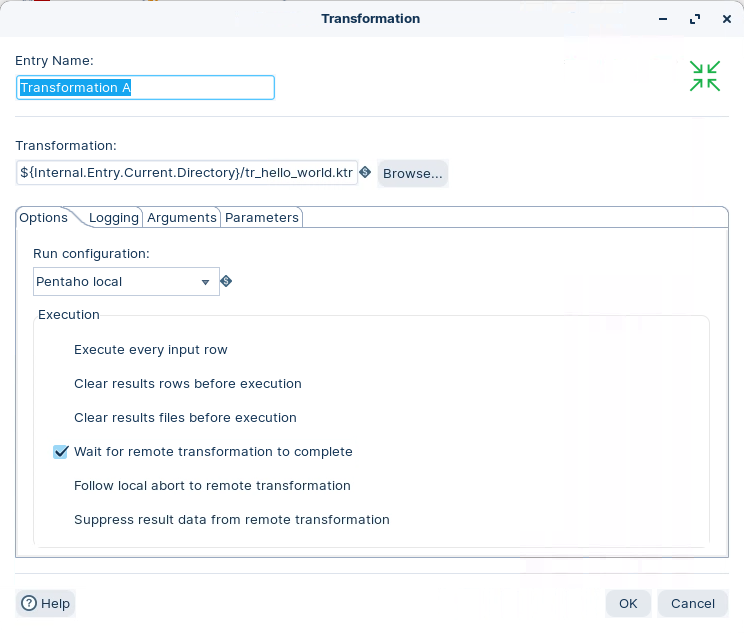
2. Double-click on the step, and configure the following properties:
Configure Transformation Job Entry
{% endtab %}
{% tab title="3. Success" %}
{% hint style="info" %}
This step clears any error state encountered in a job and forces it to a success state.
{% endhint %}
1. Drag the ‘Success’ job entry onto the canvas.
{% endtab %}
{% tab title="4. RUN" %}
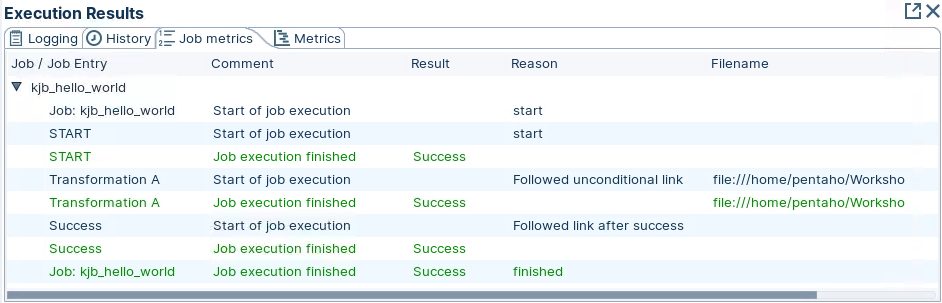
1. Click the Run button in the Canvas Toolbar.
2. Click on the Job Metrics tab.
Job Metrics
{% hint style="info" %}
The Job Entries are executed sequentially.
{% endhint %}
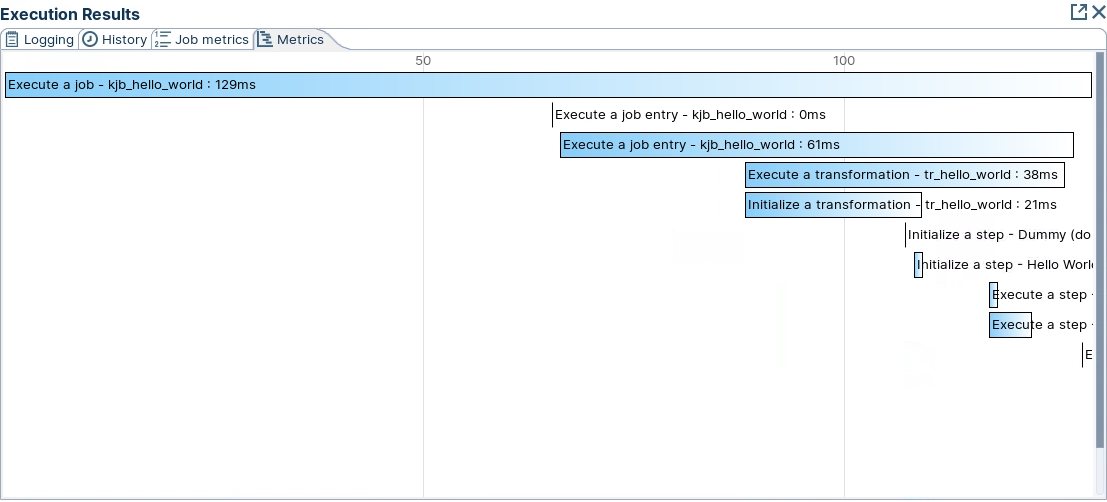
Metrics
{% endtab %}
{% endtabs %}
---
# Agent Instructions
This documentation is published with GitBook. GitBook is the documentation platform designed so that both humans and AI agents can read, navigate, and reason over technical content effectively. Learn more at gitbook.com.
## Querying This Documentation
If you need additional information that is not directly available in this page, you can query the documentation by asking a question.
Perform an HTTP GET request on the following URL with the `ask` and `goal` query parameters:
```
GET https://academy.pentaho.com/pentaho-data-integration/data-integration/enterprise-solution/jobs/job-hello-world.md?ask=&goal=
```
`ask` is the immediate question: it should be specific, self-contained, and written in natural language.
`goal` is what the user is ultimately trying to achieve, the reason they need the answer. Sharing it helps GitBook give you a better, more relevant answer. A goal is most helpful when it describes the outcome the user wants rather than restating the question. For example, with `ask=how do I create an API token`, a goal like `automate deployments from our CI pipeline` lets GitBook tailor the answer to that use case.
The response will contain a direct answer to the question and relevant excerpts and sources from the documentation.
Use this mechanism when the answer is not explicitly present in the current page, you need clarification or additional context, or you want to retrieve related documentation sections.